Pages

Showing posts with label Quakers. Show all posts

Monday, December 8, 2014

Quaker Poem Revelation John Greenleaf Whittier

From Quaker Poems A Collection of Verses


REVELATION From A Gateway to Quakerism
"And I went into the Vale of Beavor, and as I went I preached repentance to the people. And one morning, sitting by the fire, a great cloud came over me, and a temptation beset me. And it was said: All things come by Nature; and the Elements and the Stars came over me. And as I sat still and let it alone, a living hope arose in me, and a true Voice which said: There is a living God who made all things. And immediately the cloud and the temptation vanished, and Life rose over all, and my heart was glad and I praised the Living God."-- Journal of George Fox, 1690.


Still, as of old, in Beavor's Vale,
O man of God! our hope and faith
The Elements and Stars assail,
And the awed spirit holds its breath,
Blown over by a wind of death.
Takes Nature thought for such as we,
What place her human atom fills,
The weed-drift of her careless sea,
The mist on her unheeding hills?
What recks she of our helpless wills?
Strange god of Force, with fear, not love,
Its trembling worshipper! Can prayer
Reach the shut ear of Fate, or move
Unpitying Energy to spare?
What doth the cosmic Vastness care?
In vain to this dread Unconcern
For the All-Father's love we look;
In vain, in quest for it, we turn,
The storied leaves of Nature's book
The prints her rocky tablets took.
I pray for faith, I long to trust;
I listen with my heart, and hear
A Voice without a sound: "Be just,
Be true, Be merciful, revere
The Word within thee: God is near!
"A light to sky and earth unknown
pales all their lights: a mightier force
than theirs the powers of Nature own,
And, to its goal as at its source,
His Spirit moves the Universe.
"Believe and trust. Through stars and suns,
Through life and death, through soul and sense,
His wise, paternal purpose runs;
The darkness of his providence
Is star-lit with benign intents."
O joy supreme! I know the Voice,
Like none beside on earth or sea;
Yea, more, O soul of mine, rejoice,
By all that he requires of me,
I know what god himself must be.
No picture to my aid I call,
I shape no image in my prayer;
I only know in Him is all
Of life, light, beauty, everywhere,
Eternal Goodness here and there!
I know He is, and what He is,
Whose one great purpose is the good
Of all. I rest my soul on his
Immortal Love and Fatherhood;
And trust Him, as his children should.
I fear no more. The clouded face
Of Nature smiles; through all her things
Of time and space and sense I trace
The moving of the Spirit's wings,
And hear the song of hope she sings.

Wednesday, November 19, 2014

Chase Family of Kings County Nova Scotia

This is from a newspaper article in Canada September 13 1933 and from this information I found bits of information on the Chase family who came to Nova Scotia from New England. They are the descendants of the Chase family who settled Massachusetts.
They lived in the King's County area were they operated mills, tanneries, orchids, farms, and engaged in many other enterprises and trades. They were also Quakers. Please post or e-mail me if you have any information or pictures. Thank You!


From Halifax Citizen, Thursday, April 26, 1866 LIFE SIZE PHOTOGRAPHS. -- W. Chase, No. 159 Hollis Street, opposite Club House, Halifax, has now in use at his Gallery the latest and most approved Solar Camera in the city of Halifax for enlarging all styles of small pictures. Those having Daguerrotypes, Ambrotypes, and Photographs of their deceased friends and relatives can have them enlarged up to life size, and furnished at a lower price than at any other gallery. Mr. C.'s experience in Photography enables
him to give the public a more artistic style of work than can be obtained elsewhere in the city.
Lovell's 1871 Provincial Directory - Halifax City
Chase W.F., of Richards & Chase, 116 Hollis
Chase, Wellington, photographer, 159 Hollis, bds at Acadian Hotel
Chase H.N., painter, 23 Spring Garden Road
W A Chase Photo Young Lady Wellington in Nova Socotia


SS Atlantic shipwreck scene, sightseers 1, Lower Prospect, Halifax County, Nova Scotia, Canada, 1873 W. Chase NSARM #31 / negative no.: N-0721


Universal Male Suffrage: Nova Scotia, 1854
If they were over 21 and had lived in the colony at least five years, these Yarmouth merchants (photographed by Wellington Chase in the spring of 1855) were eligible to vote under the 1854 electoral law. Property ownership entitled recent immigrants to vote as well. "Universal" male suffrage did not include "Indians," however, and it lasted only until 1863, when property ownership again became a requirement.


Inauguration of the Welsford-Parker Monument, Halifax, Nova Scotia, Canada, 17 July 1860. Chase, the clever photographer succeeded in taking an excellent photographic view of the whole scene, a copy of which we have no doubt many people will hasten to secure, as a memento of the day and the event."

From Margaret Conrad Apple Blossom Time in the Annapolis Valley 1880-1957


Thanks to Library and Archives Canada 
The history of Kings County, Nova Scotia, heart of the Acadian land (1910)

Tuesday, November 18, 2014

Quaker House Dartmouth Step Back in time


There’s lots to discover at the Dartmouth Quaker House. (Tiffany Thornton) The Dartmouth Quaker House
59 Ochterloney St, Dartmouth, NS, Canada
Sources The Canadian Quaker History Journal No 71 2006 A PDF Can be sent on request
Article from Dartmouth Herald by Tiffany Thorton
It’s a rainy Saturday over the Canada Day weekend. I am on my way to the Quaker House in downtown Dartmouth to discover more about this special place that is steeped in hundreds of years of history.
From the 17th century cemetery that juts out on top of a hill off of Victoria Street, to Christ Church on Dundas street with its identifiable weather vane atop the steeple (which represents Haley's Comet). I have been meaning to get to the Quaker House since I moved here. When I arrive, I am greeted by two jovial young women dressed in traditional Quaker attire. They are excited to tell me about the history of this place.
The house was built in 1786 and was originally the home of William Ray, a cooper (barrel maker). His wife and four children set out from Nantucket with 27 other Quaker families after the American Revolution to establish the whaling industry in Nova Scotia. They left so as not to have to pay the high taxes on whale oil imported to London. But what exactly are Quakers (also known as a “Society of Friends”)? Although the history of these communities in Dartmouth is extensive, few of us know what this religion truly entailed. see Encyclopedia of American Quaker Genealogy, Volume 7, Issue 5
A tour of the house and the stories along the way help to enlighten me. Originating in England and founded by George Fox, the fundamental Quaker principle is that God is in each and everyone of us (“divine harmony”), and as such all men, women and children have the right to speak (very progressive for a time when women were not allowed to speak in church). As I tour the small home from room to room, I notice silhouette prints through out rather than actual photos. I am told that part of being a Quaker is a strong sense of modesty, with no overt displays of vanity or inequality. Photos would have represented vanity, so black and white silhouettes took their place. This caused a bit of difficulty for the museum to replicate costumes when trying to depict the clothing attire leaning towards simplicity.
The home is dark and you can gather that it would have been cold in the damp winter months. The women would weave wool into yarn for hours on end, for use in creating clothing and blankets. The wool came from the sheep on the Dartmouth Common, where the community’s livestock grazed freely. The women would also spend a lot of time in the kitchen staying warm and cooking. The men were often away for up to four years at a time, out whaling in the Atlantic (primarily for sperm whales which were valued for their oil). A fabulous display of whaling artifacts are on display, such as a whale’s skull, artworks created by the sailors and drawings of the various tools and techniques the hunters used. 
Dartmouth had established quite a name for itself during this time (1786 to 1788). Half of the whaling ships that entered London's harbor were from here; the oil they carried lighting up the streets of London and causing many in England to envy the success of the Dartmouth whalers. Eventually though, many of the Dartmouth Quaker leaders such as Samuel Starbuck and Timothy Folger (yes of Folgers coffee fame) left, setting sail for Wales with their families in tow to establish the whaling colony and town of Milford Haven. William Ray stayed on for a bit longer, but eventually he returned with his family to his birthplace of Nantucket, and the Dartmouth whaling industry faded into memory.
We are left with this incredible piece of history that can be enjoyed by all. These stories and many more line the walls of this home and the downtown streets of Dartmouth. This summer make sure to stop by the Quaker House and listen to the tales of long ago, have the kids partake in arts and crafts on Saturdays, from 11 am to 12 pm (shipbuilding, whale building and much more). Admission is $2, and donations are always welcome.


Monday, August 11, 2014

Amesbury Dedicates Park To Hackett Shipyard July 22 1930

Memorial Marker at Alliance Park Named after the first Frigate Ship authorized by the Continental Congress in 1777. Built by William and John Hackett Photo from Amesbury City
The Josiah Bartlett Chapter of the Daughters of the Revolution organization represented the home (1896-1980) when  Moses Colby donated the house and property to the Bartlett Cemetery Association as a memorial to the Colby and Macy families, and to the people of Amesbury, Massachusetts. The DOR ladies compiled scrap books and from one of the treasures is this article from July 1930. Amesbury's dedication on July 22 1930 to the legendary frigate "The Alliance" forged on the banks of the Merrimac River by the Hackett family. A large scale celebration took place that included the DOR ladies hosting a reception representing another part of Amesbury's history-Quakers which inspired John Greenleaf Whittier. If you have not visited any of the landmarks in Amesbury check out Amesbury Historical Dates and Places of Interest to plan a trip.

  Alliance, first continental Frigate built in Amesbury
                                
Alliance Park, at the confluence of the Powwow and Merrimack Rivers
                      
From Standard History Of Essex County  Massachusetts By Cyrus Mason Tracy
William Hackett built the the frigate "Alliance," owned by the Federal government. The " Alliance ” was in the memorable battle of Paul Jones, but rendered no service, on account of the jealousy between the commanders. "She carried thirty-two guns and was the favorite of the whole navy on account of her great beauty and speed. This ship had a history. She was not only named for the alliance between this country and France, but was placed in command of a Frenchman, Capt. Landois, and her first service was to convey Lafayette to his home.” Hackett afterwards drafted and superintended the building of the frigate " Essex,” at Salem, Mass. He was the master-builder and superintendent of the twenty-gun ship “ Merrimac,” of 355 tons, which was completed in seventy-five days. The " Merrimac ” was the first and best vessel of her size furnished on loan to the government. Hackett built other vessels here for many years, and afterwards bought a place below, and built a dwelling on the site of Mr. Folsom’s new residence, and established a yard in front, and continued his business, contracting for many ships. He was also the founder of a family that has produced many eminent men. The late Prof. Horatio Hackett, known as the best Greek scholar in America, was a descendant, and native of the town.

Commodore John Barry 1745-1803 Father of the American Navy
Alliance, took on two British ships, the sloop Atlanta, and the sloop, Trespassy. From Amesbury City


Old Paths and Legends of New England  By Katharine Mixer Abbott

   The Daughters of the Revolution at the Macy Colby House

More Reads:
  • William Hackett, Patriot Shipbuilder of Salisbury and Amesbury, Massachusetts Beverly J. Francis Hovanec
  • History of shipbuilding on North River
  • Colby Family and others by Ronald Colby
  • Lowell's Boat Shop  Amesbury, MA
  • James Hackett  
  • The old families of Salisbury and Amesbury, Massachusetts ; with some related families of Newbury, Haverhill, Ipswich and Hampton (1897)

Thursday, August 7, 2014

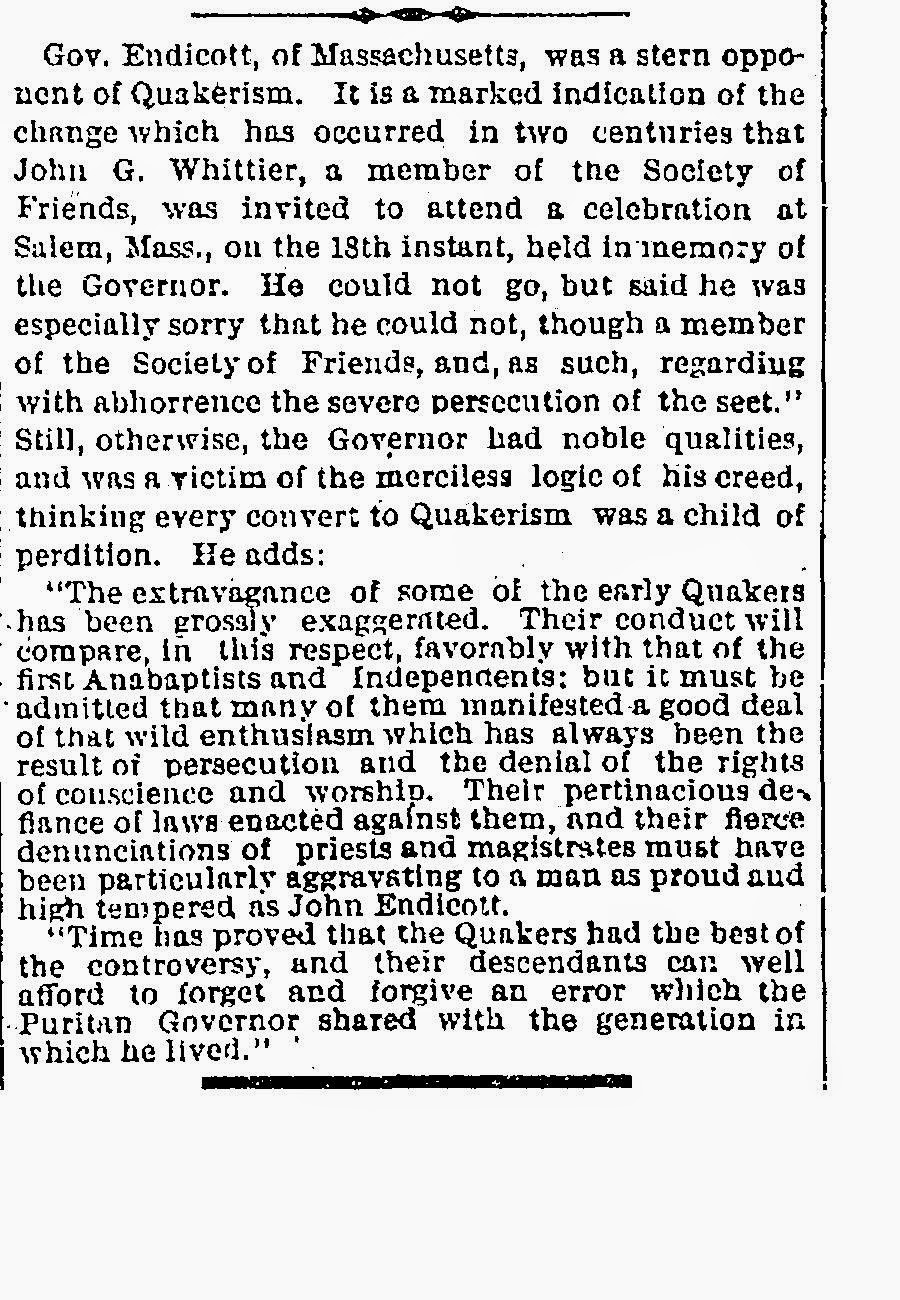
John Greenleaf Whittier Letter to decline Endicott celebraton 1878


John Greenleaf Whittier dodges Gov John Endicott ceremony in Salem Massachusetts. His letter to George M Whipple is posted below From September 22 1878 New York Times Archives


Thomas Macy court dealings with Puritans and Edward Wharton Source This year several persons were prosecuted and fined for violating the law of 1657, which prohibited ‘entertaining quakers.’ Among them was Thomas Macy, one of the first settlers of Newbury, but at this time a resident in Salisbury. Complaint having been made against him, he was summoned to appear before the general court, to answer the charges preferred against him. Instead of complying with the requisition, he sent a letter, of which the following is a copy. More on Quaker Persecutions
‘This is to entreat the honored court not to be offended because of my non-appearance. It is not from any slighting the authority of this honored court, nor from feare to answer the case, but I have bin for some weeks past very ill, and am so at present, and notwithstanding my illness, yet I, desirous to appear, have done my utmost endeavour to hire a horse, but cannot procure one at present. I being at present destitute have endeavoured to purchase, but at present cannot attaine it, but I shall relate the truth of the case as my answer should be to ye honored court, and more cannot be proved, nor so much. On a rainy morning there came to my house Edward Wharton and three men more; the said Wharton spoke to me saying that they were traveling eastward, and desire me to direct them in the way to Hampton, and asked me how far it was to Casco bay. I never saw any of ye men afore except Wharton, neither did I require their names, or who they were, byt by their carriage I thought they might b e quakers and told them so, and therefore desired them to passe on their way, saying to them I might possibly give offence in entertaining them, and as soone as the violence of the rain ceased (for it rained very hard) they went away, and I never saw them since. The time that they stayed int he house was about three quarters of an hour, but I can safely affirme it was not an houre. They spake not many word in the time, neither was I at leisure to talke with them for I came home wet to ye skin immediately afore they came to the house, and I found my wife sick in bed. If this satisfie not the honored court, I shall subject to their sentence: I have not willingly offended. I am ready to serve and obey you in the Lord,’
Tho. Macy [Essex County Court files]
Notwithstanding this explanation and apology, he was fined thirty shillings, and was ordered to be admonished by the governor, for ‘entertaining quakers,’ two of whom, William Robinson and Marmaduke Stephenson, were hung in Boston, December twenty-seventh, 1659. Tradition informs us, that Thomas Macy immediately after his sentence, took an open boat, and with his wife and children, went to Nantucket, was one of the first English settlers in that island, and there resided the remainder of his life. An amusing ballad, founded on the above-mentioned incidents, was written by the poet J.G. Whittier, and published some years ago in a Philadelphia annual.
A Collection of the Sufferings of the People Called Quakers: For the Testimony of a Good Conscience from the Time of Their Being First Distinguished by that Name in the Year 1650 to the Time of the Act Commonly Called the Act of Toleration Granted to Protestant Dissenters in the First Year of the Reign of King William the Third and Queen Mary in the Year 1689, Volume 2 
From  The history of the rise, increase, and progress, of the Christian people called Quakers


                                                   George M Whipple House in Salem
From [Gov. Endicott; Massachusetts; G. Whittier; Salem; Mass.,] Monday, September 23, 1878 Cincinnati Daily Gazette (Cincinnati, OH)


Sunday, August 3, 2014

Quaker Persecutions Colonial New England by Lucius M Sargent

 From Dealings with the Dead Volume 1 By Lucius Manlius Sargent (June 25, 1786 – June 2, 1867) author, antiquarian, and temperance advocate. Son of Daniel Sargent and Mary Turner--great granddaughter of John Turner of Salem who built what would become known as "The House of the Seven Gables."
From No. LXII. (note some spelling is not correct, but recorded as written)
Draco, I think, would have been perfectly satisfied with some portions of the primitive, colonial and town legislation of Massachusetts. Hutchinson, I 436, quotes the following decree— "Captain Stone, for abusing Mr. Ludlow, and calling him Justass, is fined an hundred pounds, and prohibited coming within the patent, without the Governor's leave, upon pain of death." 

Hazard, Hist. Coll. I 630, has preserved a law against the Quakers, published in Boston, by beat of drum. It bears date Oct. 14th, 1656. The preamble is couched, in rather strong language—" Whereas there is a cursed sect of heretics lately risen up in the world, which are commonly called Quakers, who take upon them to be immediately sent of God," &c. The statute inflicts a fine of .£100 upon any person, who brings one of them into any harbor, creek, or cove, compels him to carry such Quaker away—the Quaker to be put in the house of correction, and severely whipped; no person to speak to him. £5 penalty, for importing, dispersing, or concealing any book, containing their "devilish opinions;" 40 shillings for maintaining such opinions. £4 for persisting. House of correction and banishment, for still persisting.
The poor Quakers gave our intolerant ancestors complete vexation. Hazard, II 589, gives an extract from a law, for the special punishment of two of these unhappy people, Peter Pierson and Judah Brown—" That they shall, by the constable of Boston, be forthwith taken out of the prison, and stripped from the girdle upwards, by the executioner, tied to the cart's tail, and whipped through the town, with twenty stripes; and then carried to Roxbury, and delivered to the constable there, who is also to tie them, or cause them to be tied, in like manner, to the cart's tail, and again whip them through the town with ten stripes; and then carried to Dedham, and delivered to the constable there, who is again, in like manner, to cause them to be tied to the cart's tail, and whipped, with ten stripes, through the town, and thence they are immediately to depart the jurisdiction, at their peril."
The legislative designation of the Quakers was Quaker rogues, heretics, accursed rantors, and vagabonds.
In 1657, according to Hutchinson, I 197, "an additional law was made, by which all persons were subjected to the penalty of 40 shillings, for every hour's entertainment, given to a known Quaker, and every Quaker, after the first conviction, if a man, was to lose an ear, and a second time the other; a woman, each time, to be severely whipped; and the third time, man or woman, to have their tongues bored through, with a red-hot iron." In 1658, 10 shillings fine were levied, on every person, present at a Quaker meeting, and £5 for speaking at such meeting. In October of that year, the punishment of death was decreed against all Quakers, returning into the Colony, after banishment. Bishop, in his "New England Judged," says, that the ears of Holden, Copeland, and Rous, three Quakers, were cut off in prison. June 1, 1660, Mary Dyer was hanged for returning, after banishment. Seven persons were fined, some of them .£10 apiece, for harboring, and Edward Wharton whipped, twenty stripes, for piloting the Quakers. Several persons were brought to trial—" for adhering to the cursed sect of Quakers, not disowning themselves to be such, refusing to give civit respect, leaving their families and relations, and running from place to place, vagabond-like." Daniel Gold and Robert Harper were sentenced to be whipped, and, with Alice Courland, Mary Scott, and Hope Clifford, banished, under pain of death. William Kingsmill, Margaret Smith, Mary Trask, and Provided Southwick were sentenced to be whipped, and Hannah Phelps admonished.
Sundry others were whipped and banished, that year. John Chamberlain came to trial, with his hat on, and refused to answer. The verdict of the jury, as recorded, was—" much inclining to the cursed opinions of the Quakers." Wendlock Christopherson was sentenced to death, but suffered to fly the jurisdiction. March 14, 1660.—William Ledea, "a cursed Quaker," was hanged. Some of these Quakers, I apprehend, were determined to exhibit the naked truth to our Puritan fathers. "Deborah Wilson," says Hutchinson, I 204, "went through the streets of Salem, naked as she came into the world, for which she was well whipped." At length, Sept. 9, 1661, an order came from the King, prohibiting the capital, and even corporal, punishment of the Quakers. 

Oct. 13, 1657.—Benedict Arnold, William Baulston, Randall Howldon, Arthur Fenner, and William Feild, the Government of Rhode Island, addressed a letter, on the subject of this persecution, to the General Court of Massachusetts, in reply to one, received from them. This letter is highly creditable to the good sense and discretion of the writers—" And as concerning these Quakers, (so called)" say they, "which are now among us, we have no law, whereby to punish any, for only declaring by words, dec., their minds and understandings concerning the things and ways of God, as to salvation and an eternal condition. And we moreover finde that in those places, where these people aforesaid, in this Coloney, are most of all suffered to declare themselves freely, and are only opposed by arguments in discourse, there they least of all desire to come; and we are informed they begin to loath this place, for that they arc not opposed by the civil authority, but with all patience and meekness are suffered to sayover their pretended revelations and admonitions, nor are they like or able to gain many here to their way; and surely we find that they delight to be persecuted by the civil powers, and when they are soe, they are like to gain more adherents by the conseyte of-their patient sufferings than by consent to their pernicious sayings." 
One is taken rather by surprise, upon meeting with such a sample of admirable common sense, in an adjoining Colony, and on such a subject, at that early day—so opposite withal to those principles of action, which prevailed in Massachusetts.
The laws of the Colony, enacted from year to year, were first collected together, and ratified by the General Court, in 1648. Hutchinson, I 437, says, "Mr. Bellingham of the magistrates, and Mr. Cotton of the clergy, had the greatest share in this work."


This code was framed, by Bellingham and Cotton, with a particular regard to Moses and the tables, and a singular piece of mosaic it was. "Murder, sodomy, witchcraft, arson, and rape of a child, under ten years of age," says Hutchinson, I 440, "were the only crimes made capital in the Colony, which were capital in England." Rape, in the general sense, not being a capital offense, by the Jewish law, was not made a capital offense, in the Colony, for many years. High treason is not even named. The worship of false gods, was punished with death, with an exception, in favor of the Indians, who were fined £5 a piece, for powowing.


Blasphemy and reproaching religion were capital offenses. Adultery with a married woman, whether the man were married or single, was punished with the death of both parties; but, if the woman were single, whether the man were married or single, it was not a capital offense, in either. Man-stealing was a capital offense. So was willful perjury, with intent to take away another's life. Cursing or smiting a parent, by a child over sixteen years of age, unless in self-defense, or provoked by cruelty, or having been " unchristianly neglected in its education," was a capital offense. A stubborn, rebellious son was punished with death. There was a conviction under this law; "but the offender," says Hutchinson, ibid. 442, "was rescued from the gallows, by the King's commissioners, in 1665." The return of a "cursed Quaker," or a Romish priest, after banishment, and the denial of either of the books, of the Old or New Testament, were punished with banishment or death, at the discretion of the court. The jurisdiction of the Colony was extended, by the code of Parson Cotton and Mr. Bellingham, over the ocean; for they decreed the same punishment, for the last-named offense, when committed upon the high seas, and the General Court ratified this law. Burglary, and theft, in a house, or in the fields, on the Lord's day, were, upon a third conviction, made capital crimes. The distinction, between grand and petty larceny, which was recognized in England, till 1827, 7th and 8th. Geo. IV., ch. 29, was abolished, by the code of Cotton and Bellingham, in 1648; and theft, without limitation of value, was made punishable, by fine or whipping, and restitution of treble value. In some cases, only double. Thus, ibid. 436, we have the following entry—" Josias Plaistowe, for stealing four baskets of corn from the Indians, is ordered to return them eight baskets, to be fined five pounds, and hereafter to be called by the name of Josias, and not Mr., as formerly he used to be."
This lenity, in regard to larceny, Mr. Cotton seems to have been willing to counterbalance, by a terrible severity, on some other occasions.
Mr. Hutchinson, ibid. 442, states, that he has seen the first drought of this code, in the hand-writing of Mr. Cotton, in which there are named six offenses, made punishable with death, all which are altered, in the hand of Gov. Winthrop, and the death penalty stricken out. The six offenses were—" Profaning the Lord's day, in a careless or scornful neglect or contempt thereof— Reviling the magistrates in the highest rank, viz., the Governor and Council—Defiling a woman espoused—Incest within the Leviticus degrees—The pollution, mentioned in Leviticus xx. 13 to 16—Lying with a maid in her father's house, and keeping secret, till she is married to another." Mr. Cotton would have punished all these offenses with death.
On the subject of divorce, the code of 1648 differed from that of the present day, with us, essentially. Adultery in the wife was held to be sufficient cause, for divorce a vinculo: "but male adultery," says Hutchinson, i. 445, " after some debate and consultation with the elders, was judged not sufficient." The principle, which directed their decision, was, doubtless, the same, referred to and recognized, by Lord Chancellor Eldon, in the House of Lords, in 1801, as reported by Mr. Twain, in his Memoirs, vol. I p. 383.

MORE ON L M SARGENT & his ancestors Visit the Sargent House Museum in Gloucester MA 
From Proceedings of the Massachusetts Historical Society By Massachusetts Historical Society By Edward J Lowell

William Sargent, the great-grandfather of the subject of this notice, was born in England,1 being the son of William Sargent and Mary, his wife, whose maiden name was Epes. He was educated at Barbadoes, and moved to Gloucester in Massachusetts about the year 1678, where he acquired two acres of land on Eastern Point and built him a house.
William Sargent married, on the 21st of June, 1678, Mary, daughter of Peter Duncan, by whom he had thirteen children.' Of these the sixth was Epes Sargent, whose first wife's maiden name was Esther Macarty. Her seventh child was Daniel, born on the 18th of March, 1731, who married, on the 3d of February, 1763, Mary, daughter of the Hon. John Turner, of Salem. Below Mrs. Daniel Sargent (Mary Turner Sargent)


Daniel Sargent moved to Boston between 1770 and 1780, and occupied a store on Long Wharf, and a house in Atkinson Street (now Congress Street), near the corner of Cow Lane (now High Street). There is nothing now left in Boston to recall the old wooden houses such as this, with their gables toward the street, and their gardens where old-fashioned flowers filled the beds and where pear-trees shaded the rather ragged grass of the days when lawn-mowers were not invented. At the end of the garden was the summer-house, decorated in this case with a landscape by the hand of one of the children of the family, who had gone to England to study under Sir Benjamin West. But it must have been before this work of art was begun that, on the 25th of June, 1786, the subject of this notice, Lucius Manlius Sargent, was born. Here he lived until 1794, when the house was burnt down, and his father moved first to Fort Hill, and afterwards to the corner of Essex and Lincoln Streets.
Mr. Daniel Sargent must have been a rich man; for when he died in 1806, he left each of his six surviving children with at least a competency. He had been interested in the fisheries, and had had many dealings with the fishermen of the coast. After his death a package was found among his effects, with the following inscription: "Notes, due bills, and accounts against sundry persons along shore. Some of them may be got by suit or severe dunning: but the people are poor; most of them have had fisherman's luck. My children will do as they think best. Perhaps they will think with me, that it is best to burn the package entire." It is to the credit of Mr. Sargent's sons that they adopted his suggestion, and that all the contents of the package went into the fire. A list was first made of the evidences of debt thus destroyed, the amount exceeding thirty-two thousand dollars. The story of the occurrence and of the joy of one of the forgiven debtors is touchingly but anonymously told in the fifty-fifth number of "Dealings with the Dead."

 
Lucius Manlius Sargent went to several schools in Boston and its neighborhood, ending with the Phillips Academy at Exeter, where he remained about three years. He then entered Harvard College in the class that graduated in 1808. He left college, however, before finishing his course. He is described by a classmate as being at this time tall, handsomely proportioned, and very muscular, and as having a fine Roman cast of countenance. He was a good horseman, whether in the saddle or with the reins, a strong swimmer, and a good fencer with the broadsword. He was considered the best Latin scholar in college, and his witty sayings were quoted in his class.
After leaving college Mr. Sargent studied law in the office of Mr. Samuel Dexter. He was admitted to the bar on the 14th of March, 1815, but he never practiced. Mr. Sargent married, on the 3d of April, 1816, Mary, daughter of Mr. Barnabas Binney, of Philadelphia. By her he had three children, — Mary Turner, who died unmarried in 1841; Horace Binney, afterwards Colonel Sargent, who is still living; and Manlius, who died in infancy. Mrs. Sargent died in 1824, and in 1825 Mr. Sargent married Sarah Cutter Dunn, daughter of Mr. Samuel Dunn, of Boston. Her only child was Lucius Manlius Sargent, who served his country in the late Civil War, first as a surgeon, and then as a captain of cavalry, and who was mortally wounded at Weldon on the 9th of December, 1864.
Mr. Sargent was elected a member of the New England Historic, Genealogical Society in 1850, and a Resident Member of this Society in 1856. He died on the 2d of June, 1867, in the eighty-first year of his age. His widow, one son, and seven grandchildren survived him.
Mr. Sargent's numerous writings first appeared in newspapers and magazines, but several of them have been collected and published in more permanent forms. A volume of verse from his pen appeared in 1813, under the title of " Hubert and Ellen, with other Poems." The style is flowing, the versification good; and what is more rare, the poems are eminently readable.
About twenty years after the publication of these poems Mr. Sargent became deeply interested in the temperance reform. He delivered numerous addresses on the subject, several of which have been published. About temperance in drinking few persons deeply interested can speak temperately. The evils of drunkenness are so great that a warm-hearted or excitable man who observes them loses his head, and is almost necessarily drawn into exaggeration. Mr. Sargent did not wholly escape this danger; but his addresses were pointed, clear, and eloquent. He wrote, moreover, a series of temperance tales, which passed through several editions, and which were so well thought of that a hundred thousand copies of one of them was printed for distribution by a gentleman of New York.
But the papers which are most interesting to this Society, and to which Mr. Sargent probably owed his election here, form a series which appeared in the "Transcript" from 1847 or 1848 to 1856, and which was published in the latter year in two volumes, with the title " Dealings with the Dead by a Sexton of the Old School." The book is made up of a hundred and sixty articles, or essays, full of archaeology, criticism, and anecdote. The author was unfortunate in the character which he assumed, and we read altogether too much in his pages of tombs, graves, cremation, and undertakers. But with all this there is much that is interesting, much that is instructive. In spite of the lugubrious title, the style of the work is sufficiently lively. As is natural with a book made up of articles from a newspaper, it is better to dip into the "Dealings " than to undertake to read them consecutively.
WILLIAM SARGENT AND HIS DESCENDANTS
1. William Sargent, of Exeter, in England; m. Mary Epes; went from Exeter to Bridgetown, Barbadoes, and returned to England. His son,
2. William Sargent (called the second) born in Exeter, England, came to Gloucester previous to 1678, for he m. June 21, 1677, Mary, dau. of Peter Duncan and granddaughter of Samuel Symonds. She died Feb. 28, 1724, aged G6; he died before June, 1707. They had: 1. Fitz William, b. Jan. 6, 1678; d. Jan. 28, 1699.
2. Peter, . b. May 27, 1680; d. Feb. 11, 1724. 3. Mary, b. Dec. 29, 1681 ; m. Herrick, of Beverly. 4. Daniel, b. Oct. 31,-1685; d. July 20, 1713. Struck by lightning. 5. Jordan, b. Jan. 22,1687; d. 1689.
6. Epes, b. July 12, 1690; d. Dec. 6, 1762, aged 72. 7. Ann, b. 1692; d. Oct. 8, 1782; m. Nat. Ellery, Feb. 16, 1720 ; they had children and gr. children. 8. Andrew, b. Aug. 21, 1693. 9. Samuel, b. 1694; d. Oct. 11, 1699. 10. Fitz John, b. 1696 ; d. Jan. 20, 1697. 11. Machani, b. April 9, 1699; d. day of birth. 12. Jabez, b. Jan. 30. 1700, d. day after birth. 13. Fitz William, b. Oct. 21, 1701; d. in N. Hampshire, a "bachelor," D.S. 14. Winthrop, b. March 11, 1703.
There is much obscurity touching the birthplace of William Sargent, second. Mr. L. M. Sargent, in Ms diary (page 3), observes: "William Sargent, my great grandfather, was born in Gloucester, and married Mary Duncan, daughter of Peter Duncan, June 21, 1677, and her grandfather; Deputy Governor, performed the ceremony." If William were born in . Gloucester, it is singular that no trace of it can be found. How far the following anecdote may throw any light on the place of his nativity, the reader may judge:
"I have heard my eldest brother, Daniel, and my cousin, also much older than myself, Mr. Epes Sargent, speak of a tradition, which is extremely interesting, if true, and a very pleasant story, if false.
"William Sargent, my gr. gr. grandfather, having made his runaway match with Mary Epes, came over and settled in Gape Ann, i. e. Gloucester, Mass, having no intercourse with his family in England, who after many years, supposing him dead, gave the same name to another son, born in his absence. This other now came as mate of a brig to Cape Ann, and there met his brother. They are said to have met upon the shore, the older brother assisting to haul in the boat, as she came to land from the brig. As an Englishman he welcomed them from the old country. His interest was increased when he discovered the young man to be his fellow townsman. This led to more particular inquiries. 'Do you know an old man by the name of Sargent?' 'I have good reason to know him; he is my father.' 'Then you are my brother.'" [Diary, page 1.]


Col. Epes Sargent grandfather of L. M. Sargent. "I recollect," said an aged and respectable citizen of Gloucester, B. K. Hough, Esq. (to L. M. Sargent), " when a boy, of seeing your uncle Epes Sargent. He was a good friend to my widowed mother, and took two of my brothers aad brought them up. He died of smallpox in the old war."

  Paul Dudley Sargent entered the army of the Revolution, April, 1775, and continued therein about three years. He was present in several engagements, and was wounded at the battle of Bunker Hill. After leaving the army he resided in Salem, and engaged in navigation. In 1783 he removed to Boston and continued in the same business, but unsuccessfully; and meeting with heavy losses. he removed to Sullivan, Me. When the country was organized, he received, at one time, three commissions from Gov. Hancock—as Justice of the Peace, Judge of Probate, and Judge of the Court of Common Pleas. He was the first post-master in Sullivan, and held the office till he resigned in favor of his son. For above and other particulars, Mr. L. M. S. refers to a letter of June 2, 1845, from his granddaughter, Mrs. M. W. Wilkinson. He commanded a regiment in July, 1776, under Gen. Ward at Cambridge. [See Sparks's Washington, vol. iii. p. 456.]


Daniel Sargent (Epes,3 William,3 William1), b. March 18, 1731; m. Feb. 3, 17G3, by Rev. Mr. Barnard, to Mary, dau. of John and Mary Turner. They had seven children:
1. Daniel,5 b. Juno 15, 1764; d. April 2, 1842, aged 78.
2. Ignatius, b. Nov. 1, 1765; d. Jan. 18, 1821, aged 56.
3. John Turner, b. March 27, 1769: d. Feb. 10,1813, aged 44.
4. Henry, b. 1770; d. Feb. 21, 1845, aged 74.
5. Mary Osborne, b. Sept. 30, 1780; d. Sept. 12, 1761, aged 1.
6. Winthrop, b. Jan. 31, 1783 ; d. Jan. 11, 1808, aged 25.
7. Lucius Manlius,b. June 25, 1786; d. June 2, 1867. 
Lucius Manlius8 Sargent (Daniel Epes,3 William,3 William1), b. June 25, 1786; d. June 2, 1807; m. Mary Binney, dan. of Barnabas and Mary Binney, of Phila., April 3, 181G, by whom he had three children. She died Feb. 3, 1824.
1. Mary Turner, b. June 28, 1818; d. Aug. 2, 1811. 
2. Horace Binney, b. June 30, 1821.
3. Manlius, b. Jan. 27, 1824; d. July 3, 1825.
He m. second, Sarah Cutler, dau. of Samuel and Sarah Dunn, of Boston, July 14, 1825. 
She died Aug. 8,  1868. They had one child:
    1. Lucius Manlius, b. in Boston Sept. 15, 1820 a physician killed in battle 1864 


                                    "Camp near Falmouth, Va." by Lucius Manlius Sargent.

This drawing, from 1863, is part of a letter to Sargent's young son, George; he wrote, I shall try and get leave to come home one of these days. I hope you will be glad to see me when I come. If you are not glad, I shall be very sorry, I can tell you. I have not got anything to love here. All that I've got to love in this world is in Jamaica Plains.

Lucius Manlius Sargent JR (1826-1864) 1857 graduate of Harvard Medical School, was an accomplished draughtsman and was appointed the first artist of the Massachusetts General Hospital. At the beginning of the war, he became a surgeon with the 2nd Massachusetts Volunteers, then joined the 1st Massachusetts Cavalry in October, 1861, where he rose to the rank of Lieutenant Colonel.

                                                       Mrs. Lucius M Sargent